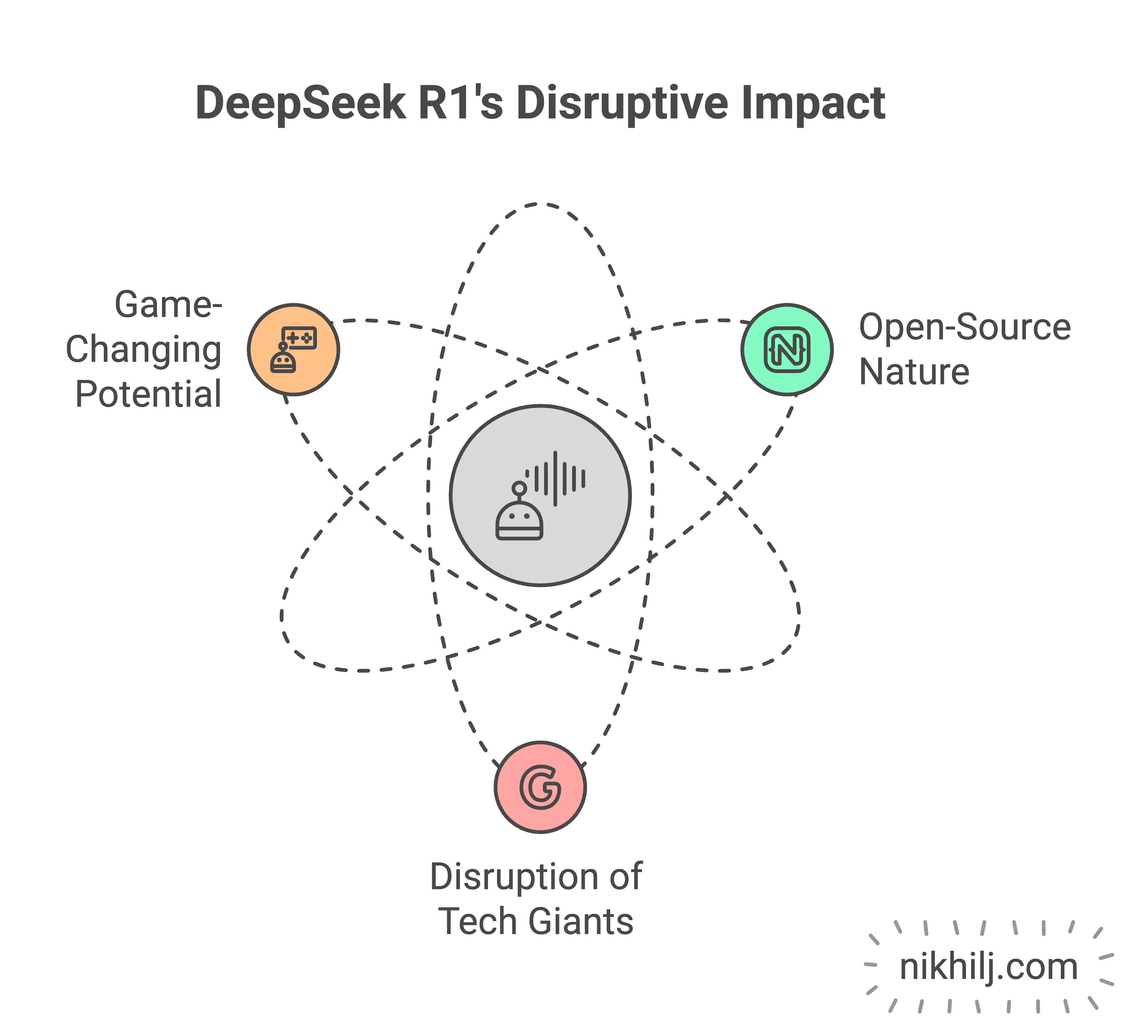
By the start of this year, a comfortable story had settled over the AI world. The race was effectively decided, the winners were the handful of giants with the most money and the biggest clusters, and the rest of us were just choosing which of them to build on. The earlier excitement, back when ChatGPT plugins first hinted at AI stepping out of the chat window, had cooled into a settled belief that scale alone decided everything. Then a model called DeepSeek R1 arrived from a team almost nobody outside the field had been watching, and the comfortable story fell apart in about a week. That is why it is the most interesting thing to happen in AI in a while, and not really because of the model itself.
I am wary of hype, so let me be careful. R1 was not magic, and the breathless takes on both sides got it wrong. But it did something that mattered more than its benchmark scores. It proved the lead was never as safe as everyone had agreed to believe.
Why an underdog model rattled everyone
The shock was not only that R1 was good. It was that it was good while being radically cheaper to train and run, and open enough that anyone could pull it apart and learn from it. The entire premise of the established order was that frontier AI required resources only a few companies on earth could marshal. R1 was a loud, public counterexample, and counterexamples are how settled stories die.
For a few days, the most powerful companies in the industry had to explain why their enormous moats were not, in fact, moats. That is a deeply healthy thing for any field to be forced to do.
The most interesting thing in AI is almost never the biggest model. It is the one that was not supposed to be possible.
What it actually means for builders
For people like me, who build on this stuff every day rather than just talk about it, the lesson was practical and freeing. It meant the capability we depend on is commoditizing faster than the incumbents would like, that we are not permanently hostage to one vendor's pricing, and that betting your product on a single model being the only option was always more fragile than it looked. Optionality went up. That is good for everyone who builds and bad only for whoever was counting on a monopoly.
It also fit a pattern I keep returning to. The thing worth paying attention to is rarely the loudest, best-funded contender. It is the quiet one doing more with less, which is usually where the genuinely interesting work hides.
The bigger lesson, beyond one model
R1 will be old news soon, replaced by whatever comes next, and that is exactly the point. The specific model matters less than what its arrival revealed: that in a field moving this fast, no lead is durable, no moat is permanent, and the assumption that the giants have already won is the most dangerous assumption a builder can hold. The race is not decided. It keeps not being decided, and an underdog from nowhere is always one good idea away from reminding everyone of that.
I find that genuinely energizing, and a little destabilizing, which is probably the correct way to feel about any field worth working in. The moment we are certain we know who wins is the moment we have stopped paying attention to the person about to prove us wrong. It is the builder's posture I keep coming back to, the one I wrote about in Fable and the Grid: stay close to the work, stay loyal to no single tool.